

Let’s say a chum of yours journeys and faceplants onto a concrete ground. There’s an enormous thud, and blood is gushing from his nostril and a laceration on his eyebrow. Main ouch.
You, too, can really feel ache as face meets ground or even the aftershock of it. You begin to really feel dangerous for them and rush over to lend a hand.
Now, what you might (or would possibly not) understand is, you’ve simply skilled empathy and compassion. Have you learnt which one is which?
That’s the article with synonyms. We use them interchangeably, like in terms of compassion vs. empathy.
No longer that there’s anything else mistaken with it. However, like people, phrases are distinctive. There’s a explanation why a stumble is named a stumble and no longer a fall.
And while you perceive the which means in the back of the phrase, you get started responding to the arena extra consciously as an alternative of simply reacting to its ache.
What’s empathy?
Empathy is what occurs when you’re feeling any person else’s feelings as though they have been your individual. You’re in a position to sense what they’re going thru with out a unmarried phrase being spoken.
It’s human intuition, truly. Analysis even unearths that while you witness any person else in ache, the anterior insula and the anterior cingulate cortex illuminate. Those are the similar mind areas that procedure your individual ache.
It’s one of those emotional resonance, the place you actually really feel with others. That’s very similar to when your buddy’s face high-fived the ground.
However it doesn’t revolve only round ache. In keeping with psychiatrist Dr. Judith Orloff, you’ll be able to additionally reflect pleasure, worry, interest, pleasure, and so forth.
That’s why empathy isn’t only one factor. There are in truth 3 layers:
- Cognitive empathy is what is helping you know what any person feels.
- Emotional empathy allows you to percentage that feeling on your personal frame.
- Compassionate empathy strikes you to do something positive about it.
They regularly overlap, and each and every turns on a special a part of the mind that shapes how we attach.
No longer best that, however as Dr. Orloff issues out in her guide, The Genius of Empathy, empathy is its personal type of therapeutic, whether or not you’re giving or receiving it. She writes, “It’s some way of claiming you subject to me, the earth issues to me, being type to myself and others issues to me.”
And that’s the wonderful thing about empathy. It reminds us how deeply we’re stressed out to care.
What empathy isn’t
Folks regularly romanticize empathy, whether or not we love to confess it or no longer. Folks deal with it like a superpower, however part the time, it’s a kind of emotional intelligence that we regularly misuse.
When it leaks out of steadiness, it becomes one thing that appears like care however quietly empties you. So right here’s what empathy is no longer:
- A rescue undertaking. It doesn’t pull other folks out of ache.
- An emotional sponge. It doesn’t soak up the whole thing it feels.
- A efficiency. It doesn’t want to be noticed to be genuine.
- A weak point. It doesn’t make you fragile.
- The similar as sympathy. It doesn’t watch from a distance.
- An ethical badge. It doesn’t turn out goodness.
- A ensure of reality. It doesn’t all the time perceive the tale.
The truth of the subject is, empathy loses its power when it’s puzzled with emotional overreach or self-sacrifice. It’s supposed to be the bridge, no longer the vacation spot.
And what waits at the different aspect is compassion.
What’s compassion?
If empathy allows you to really feel any person’s ache, compassion strikes you to ease it. It’s the herbal subsequent step when figuring out becomes care. So, within the example of your buddy falling, it might be when you’re feeling dangerous and pass over to lend a hand.
“Compassion is expressing the purpose of transferring from judgment to worrying, from isolation to connection, from indifference or dislike to figuring out,” explains Vishen, the founding father of Mindvalley, in his 6 Section Meditation program.
Even throughout traditions, compassion has been described because the best type of emotional adulthood. In Buddhism, it’s karuṇā, which is the willingness to stick open within the presence of ache. In psychology, it’s noticed because the steadiness between sensitivity and power.
Neuroscience reveals that the similar mind areas that deal with love and praise additionally turn on compassion. They invent emotions of heat and motivation, and that’s why working towards this emotional state can depart you extra energized, no longer much less.
“All folks can pass from being judgmental to being actually loving and type,” Vishen says. And while you do this, “you’re no longer simply higher to the folk round you. The arena feels higher as a result of [with] everybody round you, you get started figuring out that they’re human identical to you.”
What compassion isn’t
Folks regularly talk of compassion as a distinctive feature, however that halo impact it has can regularly blur its reality. So right here’s what compassion is no longer:
- Pity. It doesn’t glance down on ache.
- Martyrdom. It doesn’t ask you to burn out.
- Saviorism. It doesn’t attempt to repair other folks.
- Pressured positivity. It doesn’t pretend calm or mild.
- A transaction. It doesn’t stay ranking.
In keeping with Vishen, it’s simple to underestimate compassion. “For the longest time in society,” he says in an interview with Jay Shetty, “we idea kindness is [sic] related to weak point.”
However compassion, he is going on to provide an explanation for, is sort of a muscle. “While you educate it, you turn out to be extra loving.”
Figuring out compassion vs. empathy
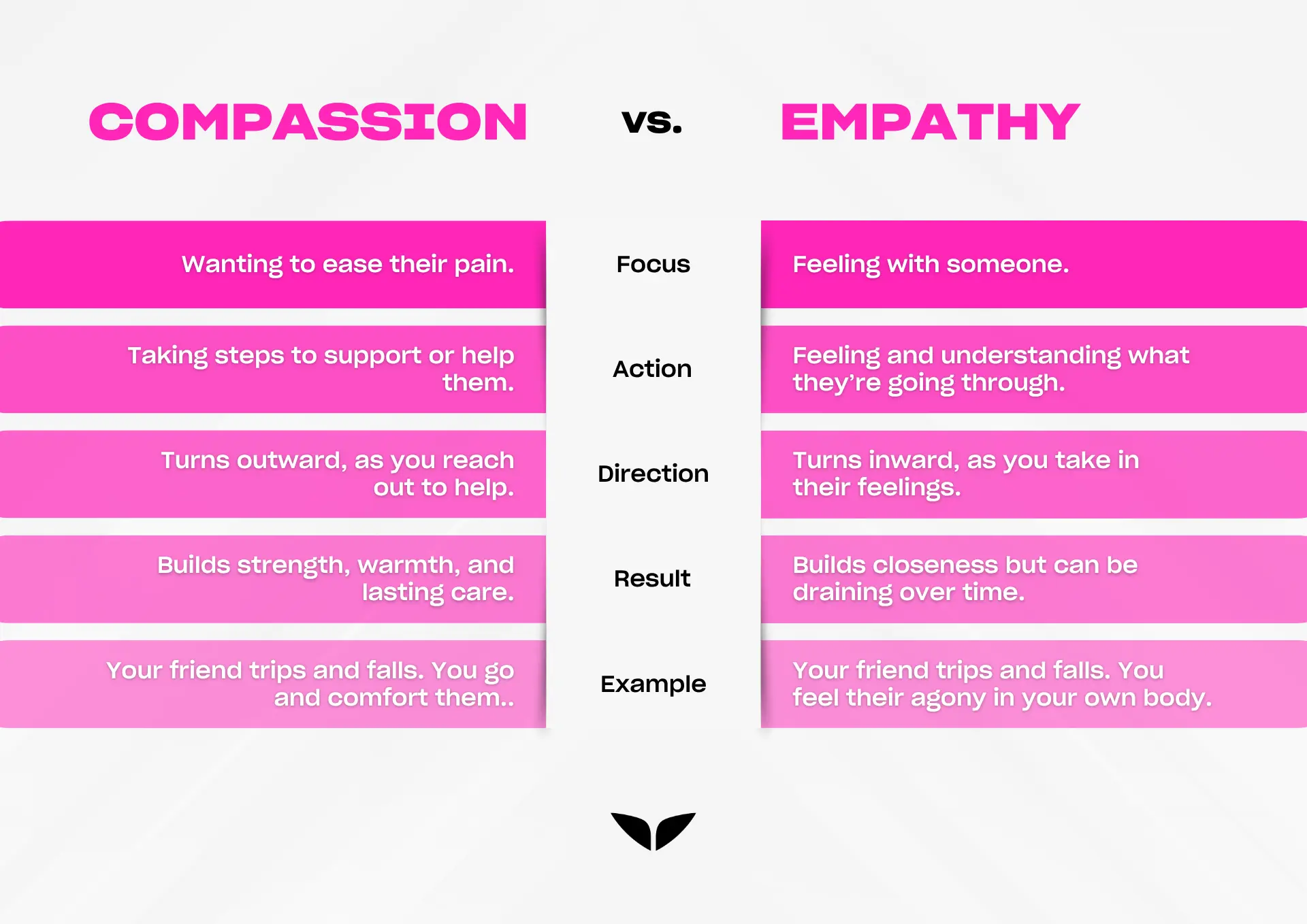
While you’re having a look at empathy vs. compassion at the floor, they are able to look like one and the similar. However while you take a look at them aspect by means of aspect, you’ll see why each and every merits to face as its personal phrase.
| Facet | Empathy | Compassion |
| Focal point | Feeling with any person | In need of to ease their struggling |
| Motion | An emotional reaction that is helping you know what they’re going thru | Taking mindful steps to enhance or relieve ache |
| Path | Turns inward as you replicate and internalize some other’s emotions | Turns outward as you channel care into motion |
| Consequence | Builds emotional connection however may end up in empathic misery when unregulated | Builds resilience and sustainable connection thru certain motivation |
| Instance: Your buddy journeys and falls… | You’re feeling their agony on your personal frame | You set into motion what you’ve discovered about how one can convenience any person |
Empathy vs. sympathy vs. compassion vs. pity
So that you’ve were given the comparability between empathy and compassion. However there are a couple of others that regularly get thrown into the combo that, should you’re no longer a local English speaker, would possibly get you pondering, Goodness, what now …
Buddhist monk Gelong Thubten has an opinion about this (particularly compassion). In his Changing into Extra Loving program on Mindvalley, he says, “Occasionally I believe when other folks pay attention the phrase compassion, they possibly combine it up with an concept of pity or having a look down on anyone, or simply feeling an excessively sturdy more or less empathy and feeling unsatisfied as a result of others are struggling.”
When it comes to your buddy faceplanting, when do you’re feeling empathy vs. sympathy vs. compassion? And what about pity?
So check out all 4, aspect by means of aspect:
| Facet | Pity | Sympathy | Empathy | Compassion |
| Focal point | Gazing any person’s affected by a distance | Acknowledging any person’s hardship | Feeling some other’s feelings as your individual | In need of to ease some other’s struggling |
| Motion | Feeling sorry for them | Providing convenience or phrases of enhance | Emotionally resonating and connecting | Taking motion to enhance or relieve ache |
| Path | Shallow | Average | Deep | Private |
| Consequence | Creates separation and hierarchy | Creates figuring out however helps to keep emotional distance | Builds closeness however may end up in emotional fatigue | Creates sustained connection and emotional steadiness |
| Instance: Your buddy fell… | You suppose, “deficient factor.” | You assert to them, “I’m so sorry; that should’ve harm.” | You fret over the ache with them. | You hang area for them and lend a hand them heal over the years. |
What’s extra essential, compassion or empathy?
The article with a majority of these feelings is they paintings in combination as portions of the similar emotional intelligence. Even in a single situation, you’ll be able to transfer thru them fluidly, so that you don’t truly have to select to really feel one over the opposite.
“Empathy and compassion play a central position in therapeutic,” Dr. Orloff explains.
The previous opens you as much as someone else’s international. Then again, an excessive amount of of it will probably flood your device and blur the perimeters of the place you finish and so they start.
The latter then steadies that reaction. It acts because the regulator and turns uncooked feeling into grounded care.
So it’s no longer such a lot about compassion vs. empathy however extra about how you’ll be able to get them to paintings in steadiness. When you’ll be able to do this, you’re in a position to stick hooked up with out collapsing, mindful with out soaking up, and provide with out dropping your self.
You’ll be able to’t forget about your individual wishes and be expecting to heal your self. It simply gained’t paintings.
— Dr. Judith Orloff, psychiatrist and writer of The Genius of Empathy
How one can domesticate compassion and empathy in an unique means
Likelihood is that, you’re involved along with your empathetic and compassionate aspect. However should you’d love to support it additional, those expert-backed practices can information the best way.
1. Get started with self-empathy
“You’ll be able to’t forget about your individual wishes and be expecting to heal your self,” Dr. Orloff issues out. “It simply gained’t paintings.”
That’s the entire level of self-empathy. It asks you to decelerate and see what’s taking place inside of earlier than tuning in to any person else. And while you accomplish that, analysis says, your mind can calm tension, secure your feelings, and make it more straightforward to connect to others.
The truth of the subject is, while you perceive your individual feelings, you’re in a position to prevent projecting them onto others. What’s extra, you’ll be able to keep in touch extra obviously, react much less, and pay attention higher.
There are some things you’ll be able to do to paintings in this:
- Realize how you’re feeling. Pause for a second all through your day and take a look at in along with your frame—your shoulders, your breath, your heartbeat. Ask your self, “What am I feeling at this time?” and let the solution come with out judgment.
- Grounding ways like deep respiring, strolling in nature, or journaling to procedure emotion as an alternative of suppressing it.
- Delicate self-talk. Discuss to your self with persistence, no longer drive.
“The way you deal with your self impacts your well being and well-being,” says Dr. Orloff. And whether or not you’re in ache or pain-free, glad or unhappy, targeted or scattered, each are ok. “You’re by yourself aspect in all cases.”
2. Construct wholesome obstacles
Surroundings obstacles isn’t regularly thought to be a talent. However it’s one who’s a part of Dr. Orloff’s teachings.
“This talent is the basis of wholesome relationships and is helping maintain your sensitivities,” she explains. Analysis presentations that folks with transparent emotional obstacles enjoy decrease tension and no more burnout.
The article is, while you’re cultivating empathy with no need obstacles in position, burnout and empathy fatigue (the place you don’t have anything left to offer to others or your self) can happen. Dr. Orloff places it as “there aren’t any guardrails to carry directly to or boundaries to remember.” And that’s a large drawback.
So what does environment those obstacles appear to be?
- Repeat this confirmation. “It isn’t my task to tackle other folks’s ache. I will be worrying with out onerous myself.”
- Observe announcing no with out guilt. It additionally way understanding your limits and expressing them kindly however firmly so you’ll be able to maintain others with out neglecting your self.
Dr. Orloff herself needed to learn how to do that, respectfully, in fact. And she or he discovered that her sense of self worth turned into more potent. She says, “When I may catch this trend and display it extra love, I didn’t give it the facility to take me down.”
3. Put empathy in motion
There are many tactics you’ll be able to get started imposing empathy:
- Concentrate actively. Give your complete consideration with out making plans your answer.
- Be curious. Ask questions that invite figuring out as an alternative of judgment.
- Keep open. Let other folks really feel secure to percentage with out fearing correction or critique.
They’re small movements, positive. However as a result of they construct believe, ease pressure, and remind other folks they’re noticed, their have an effect on is unbelievable.
“Cultivating empathy is non violent warrior coaching,” says Dr. Orloff. “You’ll learn how to be each sturdy and loving, neither a pushover nor inflexible.”
And over the years, that more or less empathy naturally grows into compassion.
4. Observe self-compassion
Compassion is a self-discipline of the guts. And on that, Gelong is knowledgeable. As an issue of truth, his Changing into Extra Loving program facilities on figuring out it and increasing yours till it turns into some way of being.
So right here’s what he suggests doing for self-compassion:
- Calm your thoughts thru easy respiring meditation.
- Each and every time you realize your thoughts wandering, gently convey it again.
That is coaching in forgiveness. And it’s compassion in its maximum sensible shape: assembly your self with persistence as an alternative of frustration.
“It’s truly a way of increasing the guts,” Gelong explains. “It’s a way of connecting with all sentient beings. A way of one thing truly endless, one thing unconditional, one thing very natural.”
When you’re in a position to try this for your self, then it’s time to extend that feeling outward.
“We need to transfer past the bounds of our proscribing self, our proscribing ego,” Gelong provides. Start with any person you like, transfer to strangers, and, while you’re in a position, come with everybody, even those that problem you.
5. Set compassion as your purpose
Compassion is without doubt one of the six stages of Vishen’s extremely robust and distinguished meditation program. And for a just right explanation why.
“Compassion is set surrendering to the most productive model of your self,” he says. Analysis from the HeartMath Institute presentations that it creates center coherence, the place your feelings, thoughts, and frame fall into cohesion. That’s the power you radiate while you reside from purpose as an alternative of response.
To start to learn to do this, Vishen teaches a easy but profound workout:
- Visualize any person you like, like a spouse, a kid, or perhaps a puppy.
- Then, really feel the heat of that love on your center. See that love as mild, and with each and every breath, extend it.
- Fill your self with it first, then your house, your community, your town, and ultimately all the planet.
That is what he way, as up to now discussed, by means of compassion being an expression of “the purpose of transferring from judgment to worrying, from isolation to connection, from indifference or dislike to figuring out.”
Each and every time you apply it, you lift the emotional box round you. And in doing so, you remind others to do the similar.
Compassion vs. empathy: real-life examples
Seeing others in motion doing just right has a contagious impact. Like when any person can pay for a stranger’s espresso, and everybody in line needs to do the similar.
That is what’s referred to as ethical elevation. Analysis presentations that after we witness any person doing just right, our brains free up oxytocin and turn on the similar neural circuits connected to connection and care.
The arena feels higher as a result of [with] everybody round you, you get started figuring out that they’re human identical to you.
— Vishen, founding father of Mindvalley and teacher of the 6 Section Meditation program
Listed here are a couple of empathy vs. compassion examples in genuine lifestyles. Would possibly it encourage you to do the similar.
Empathy
Letting any person else be proper. Dr. Orloff relays the tale of a chum who was once positive her daughter’s dating was once doomed. As an alternative of arguing, Dr. Orloff merely mentioned, “Ok, you appear positive,” and left it there. Liberating the urge to be proper allowed her buddy to really feel heard (although her prediction didn’t come true). And that made area for connection.
When a tale touches the guts. Photographer Brandon Stanton, the author of People of New York, as soon as stopped a center college pupil named Vidal at the streets of Brooklyn. The boy spoke about his foremost, Ms. Lopez, and the way she impressed him on a daily basis. Stanton was once deeply moved by means of the best way Vidal described her, and that straightforward second of listening ultimately ended in a collaborative marketing campaign to fund a faculty commute to Harvard.
Attaining out to be understood. In 2004, a person in Sydney referred to as Juan Mann stood in a hectic mall preserving a cardboard signal that learn “Loose Hugs.” After feeling lonely and disconnected, he sensed others would possibly really feel the similar. A easy hug turned into his means of claiming, “I see you. I think it too.”
Compassion
Opting for figuring out over judgment. After the town reopened from lockdown, Vishen went to a cafe with a chum. The carrier was once sluggish, the espresso arrived chilly, and the meals took ages. When the invoice got here, as an alternative of complaining, he left the waitress a beneficiant tip. He selected to look her state of affairs thru compassion: the strain of returning to paintings, the exhaustion of lengthy shifts, and the drive of serving a packed eating place after months of uncertainty.
The guts of management. After 27 years in jail, Nelson Mandela selected harmony over revenge. As president of South Africa, he embraced the nationwide rugby workforce, the Springboks (who have been as soon as noticed as a logo of apartheid), and inspired the country to enhance them. It was once a second of profound compassion: the verdict to steer with forgiveness, to behave from figuring out fairly than anger.
Self-compassion in therapeutic. Penny Winn, a author from the USA, came upon The 6 Section Meditation whilst suffering with PTSD. On the lookout for calm one evening, she discovered Vishen’s guided meditation on YouTube and started the use of it to regulate her nervousness and reconnect with herself.
“His concepts on compassion, love, forgiveness, and taking non-public duty on your construction in opposition to the following 3 years has truly moved me ahead in my PTSD and religious expansion,” she stocks. As a result of, now and again, gentleness is what is helping you start once more.
Ceaselessly requested questions
Are you able to have compassion with out empathy?
Sure, it’s conceivable. In contrast to empathy, compassion doesn’t depend on emotional resonance on my own. It may possibly additionally get up from mindful purpose.
As Dr. Orloff explains, “Compassion is regularly a reaction to empathizing with any person that may spark our impulse to lend a hand, however no longer everybody with empathy is spurred into motion.”
In different phrases, empathy can open the door to compassion, but it surely’s no longer the one means in. You’ll be able to consciously select to behave with care and figuring out even while you don’t really feel someone else’s ache.
That’s why medical doctors, therapists, and caregivers apply cultivating compassion. It permits them to keep type and efficient with out emotional overload.
What’s the distinction between empathy, altruism, and compassion?
Empathy allows you to really feel. Compassion strikes you to care. And altruism? It compels you to behave.
They regularly paintings in combination however aren’t depending on each and every different. Empathy may end up in compassion, and compassion can encourage altruism.
But, you’ll be able to even have altruism with out empathy or compassion with out emotional resonance.
Is there a depressing aspect to empathy?
There can also be. Empathy, whilst gorgeous, has limits. When you are taking on an excessive amount of of someone else’s ache, your worried device can’t inform the place you finish and so they start. Mavens name this state empathetic misery.
Analysis from the Max Planck Institute additionally discovered that over the top empathy turns on the similar mind areas as bodily ache. So, with out law, this may end up in burnout, nervousness, and avoidance.
That’s why empathy on my own isn’t sufficient. It wishes the stabilizing presence of compassion.
Develop into a changemaker
You’ve explored empathy. You’ve felt compassion. Now believe turning each right into a day-to-day apply that rewires the way you suppose, really feel, and transfer throughout the international.
That’s what Vishen Lakhiani’s 6 Section Meditation does. In simply 20 mins an afternoon, you’ll transfer thru six robust stages designed to rouse love, gratitude, forgiveness, imaginative and prescient, mastery, and blessing. And with it, you’ll:
- Teach your thoughts to stick calm and transparent, even in chaos.
- Open your center to deeper compassion and connection.
- Reside every day with objective, focal point, and pleasure.
International-class athletes, artists, and leaders use this radically sensible meditation. One such individual is Bianca Andreescu, a qualified tennis participant who beat Serena Williams within the 2019 US Open. She stocks:
It has undoubtedly modified my lifestyles, and simply know that you just’re no longer best converting my lifestyles, however you additionally exchange hundreds of thousands of lives.
You’ll be able to now get entry to the 6 Section Meditation program totally free and uncover how briefly your interior international can turn into your outer one.
Welcome in.

