

Google “poems,” and chances are high that, a well-liked poet named Rumi will pop up. And deservedly so.
Rumi poems is also loads of years previous, however they’re simply as related as of late as they had been once they had been first written.
Who’s he, it’s possible you’ll ask? Formally referred to as Jalal ad-Din Muhammad Rumi, this Thirteenth-century Persian poet and Islamic pupil took the arena by way of typhoon along with his exceptional present of writing. What he’s executed with poems is largely similar to what Michael Jordan has executed with basketball.
Centuries will have handed, however those best 10 Rumi poems end up something: the truths that transfer us maximum deeply by no means cross out of favor.
Rumi’s love poems
Love poems hit other. Greater than mere tales, they seize the guts of what it method to be human, to be susceptible, and to be attached. They ceaselessly change into therapeutic quotes we go back to after we want convenience or readability.
And Rumi’s love poems? They’re no exception.
He noticed love as a bridge—a approach to attach the earthly and the divine. His phrases raise that sense of longing and beauty, making you’re feeling like love isn’t simply an emotion however a type of magic that’s all the time been there, ready to be felt.
All Rivers at As soon as
What’s the frame? Staying power.
What’s love? Gratitude.
What’s hidden in our chests? Laughter.
What else? Compassion.
This poem looks like Rumi handing you a cheat sheet to lifestyles. It’s easy, instantly to the purpose, and full of which means.
The frame is staying power—as a result of, let’s face it, lifestyles throws so much at us, and our bodily selves are constructed to carry on. Love is gratitude, reminding us that appreciating overrides taking. Laughter and compassion hidden in our chests? It’s like he’s pronouncing the whole lot we want to navigate this labyrinth of happiness already inside of us.
Rumi’s magic here’s in how he makes lifestyles’s large concepts really feel so relatable.
This Marriage
Might those vows and this marriage be blessed.
Might it’s candy milk,
this marriage, like wine and halvah.
Might this marriage be offering fruit and coloration
just like the date palm.
Might this marriage be stuffed with laughter,
our each day an afternoon in paradise.
Might this marriage be an indication of compassion,
a seal of happiness right here and hereafter.
Might this marriage have an excellent face and a just right identify,
an omen as welcomes the moon in a transparent blue sky.
I’m out of phrases to explain
how spirit mingles on this marriage.
Writing about marriage? That’s for amateurs. Rumi, effectively, he paints it like a masterpiece.
Each and every line drips with richness—candy milk, wine, halvah, date fingers—it’s like he’s appearing us how an excellent marriage will have to style and really feel. It’s about developing one thing sacred, completely happy, and everlasting.
And that final line? “I’m out of phrases to explain how spirit mingles on this marriage.” It’s like he’s pronouncing the most efficient issues in lifestyles—love, connection, union—can’t be absolutely defined, most effective felt.
The Minute I Heard My First Love Tale
The minute I heard my past love tale,
I began on the lookout for you,
no longer realizing how blind that was once.
Fanatics don’t after all meet someplace.
They’re in each and every different all alongside.
This poem flips the entire thought of affection on its head. Rumi’s pronouncing that love isn’t about going out into the arena to search out any individual—it’s already there, inside of you.
This concept ties intently to Sufi teachings, which view love as a divine pressure inside of each and every people, ready to be woke up. Students have even famous how Rumi’s poetry displays this trust, appearing that the affection we search externally is already a part of who we’re.
It’s a superbly easy approach of reminding us to prevent looking and get started noticing what’s already inside of.

Rumi’s poems about lifestyles
Lifestyles isn’t simple, and the poet by no means pretended it was once. However Rumi’s poems about lifestyles really feel like a gradual hand to your shoulder, reminding you that even in chaos, there’s which means.
Similar to as of late’s highest self-help books, his phrases discover lifestyles’s messiness—its good looks, its ache, its uncertainty—and switch it into one thing sacred. Those verses don’t simply let you know to are living absolutely; they make you wish to have to.
Best Breath
Now not Christian or Jew or Muslim, no longer Hindu
Buddhist, sufi, or zen. Now not any faith
or cultural gadget. It’s not that i am from the East
or the West, no longer out of the sea or up
from the bottom, no longer herbal or airy, no longer
composed of parts in any respect. I don’t exist,
am no longer an entity on this global or within the subsequent,
didn’t descend from Adam and Eve or any
beginning tale. My position is placeless, a hint
of the traceless. Neither frame or soul.
I belong to the cherished, have observed the 2
worlds as one and that one name to and know,
first, final, outer, inside, most effective that
breath respiring human being.
“Best Breath” is a kind of poems by way of Rumi that strips away surface-level variations—faith, tradition, id—and makes a speciality of the oneness that connects us all. It’s a mirrored image of the way even uncomfortable feelings can lead us towards one thing higher.
As physicist Nassim Haramein places it, “The universe is attached and alive, and we’re part of the metric of area.” It’s a phenomenal intersection between poetry and science, each pointing us towards the similar fact: we’re all a part of one thing a lot larger than ourselves.
The Makes use of of Worry
A donkey turning a millstone isn’t attempting
To press oil from sesame seed. He’s fleeing the blow
that was once simply struck and hoping to keep away from the following.
We glance to ease our ache, and this assists in keeping civilization
Transferring alongside. Worry is the architect right here.
Worry assists in keeping us operating close to the ark.
From time to time even though, it’s concern, a contracting,
That brings you into the presence.
Rumi takes concern and turns it into one thing positive. He compares it to a donkey operating from blows, pushing a millstone that assists in keeping civilization shifting. In different phrases, concern motivates us to behave—it will probably stay us protected and power development.
However Rumi doesn’t forestall there; he hints at a deeper fact: concern is what pulls us nearer to the divine. It’s a reminder that even uncomfortable feelings can serve a better function.
Sufficient Phrases?
However that shadow has been serving you!
What hurts you, blesses you.
Darkness is your candle.
Your obstacles are your quest.
You should have shadow and lightweight supply each.
Concentrate, and lay your head below the tree of awe.
This one’s all about duality—gentle and shadow, ache and enlargement, obstacles and freedom. Rumi shifts the narrative to ache and darkness, pronouncing they’re no longer enemies however lecturers.
“Darkness is your candle” implies that the very issues that harm or problem us too can remove darkness from our trail. The decision to “lay your head below the tree of awe” is a call for participation to embody the thriller of lifestyles, accepting each the struggles and the wonder as a part of our adventure.
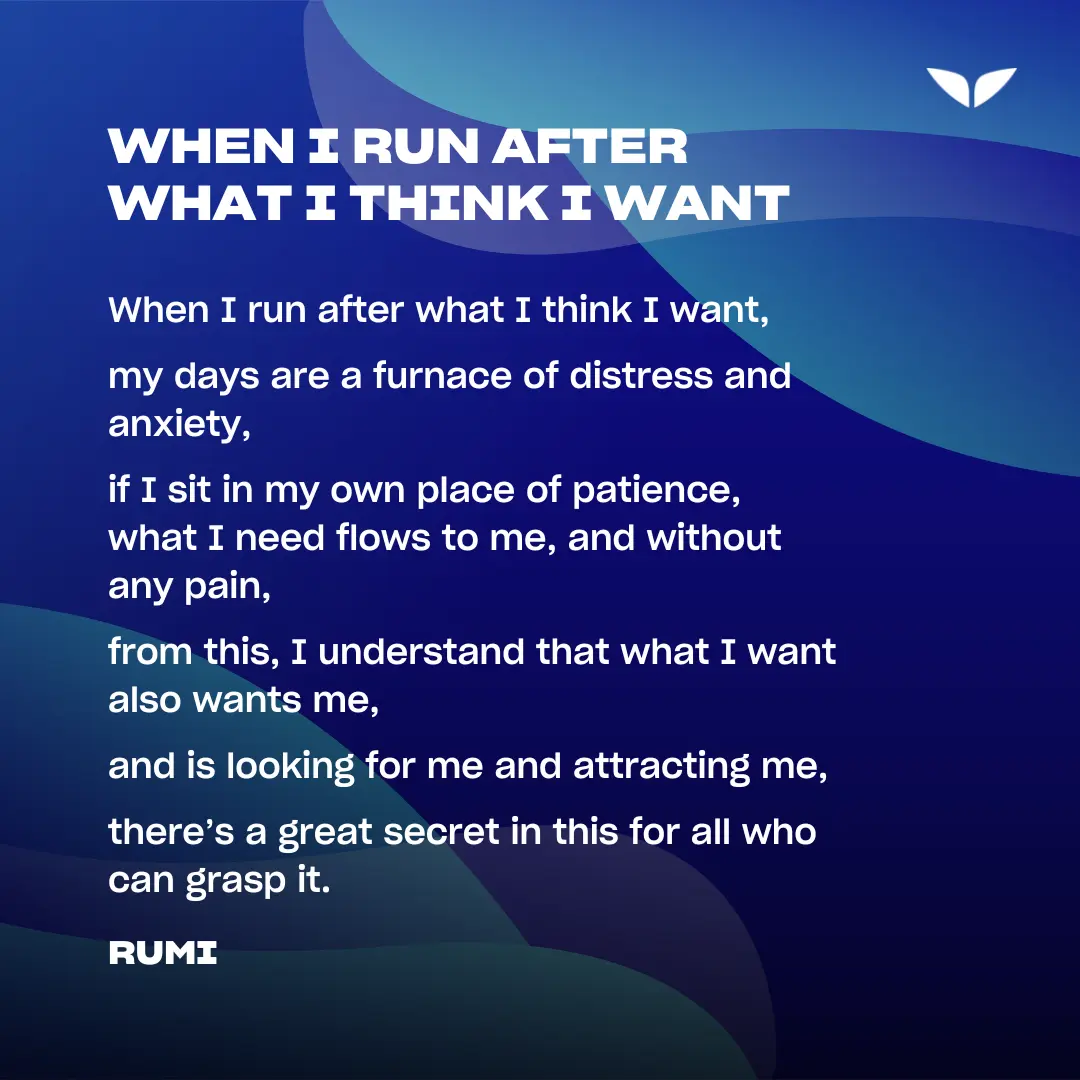
Once I Run After What I Assume I Need
Once I run after what I feel I need,
my days are a furnace of misery and nervousness,
if I take a seat in my very own position of persistence,
what I would like flows to me, and with none ache,
from this, I needless to say what I need additionally desires me,
and is on the lookout for me and attracting me,
there’s an excellent secret on this for all who can grab it.
This poem is like Rumi’s approach of claiming, “Forestall operating your self ragged.”
Vishen, the founder and CEO of Mindvalley, talks about this so much—how we’re taught to chase after stuff like levels, promotions, and the following large factor, considering that’s what’s going to make us glad.
However Rumi has a distinct tackle it. He’s pronouncing that what you in point of fact want is already on the lookout for you, and the trick is to prevent chasing and simply pay attention on your soul.
Vishen sums it up properly: “Don’t music in to the foundations of the arena that let you know who to be or what to need or what to do. As a substitute, be who you in reality are, pay attention to that soul, and know that what the soul desires, the universe desires you to have.”
Quick Rumi poems
From time to time, only some phrases can hit more difficult than a complete novel, and Rumi mastered that artwork. His brief poems are like little drops of knowledge that ripple out into one thing larger.
They’re fast to learn however stick to you, providing flashes of readability in the course of lifestyles’s noise. It’s no surprise other people nonetheless flip to Rumi’s poetry—his must-read poems simply get it.
Craftsmanship and Vacancy
Don’t pay attention to them!
They appear to offer protection to,
However they imprison.
They’re your worst enemies.
They make you afraid
Of residing in vacancy.
Rumi is looking out the concern of letting cross. The voices that let us know to carry directly to construction and keep an eye on—the “they” on this poem—aren’t serving to. They maintain us caught, afraid to embody vacancy, which he sees as the distance the place freedom and creativity thrive.
The message here’s to transport past the relief of protection and embody the unknown as an area for enlargement and creativity.
Spread Your Personal Delusion
However don’t be glad with tales,
How issues have long past with others.
Spread your individual fantasy,
With out sophisticated rationalization,
So everybody will perceive the passage,
We’ve got opened you.
This one’s all about proudly owning your tale. Rumi demanding situations us to prevent residing during the studies of others and get started developing our personal narrative.
“Spread Your Personal Delusion” is a call for participation to embody what makes you distinctive with out overthinking or complicating it. It’s a formidable approach of claiming, “Your lifestyles is yours to are living—make it significant in some way that resonates with the arena.”
And it seems, making a lifestyles that displays who you aren’t most effective feels releasing however too can spice up happiness and well-being.
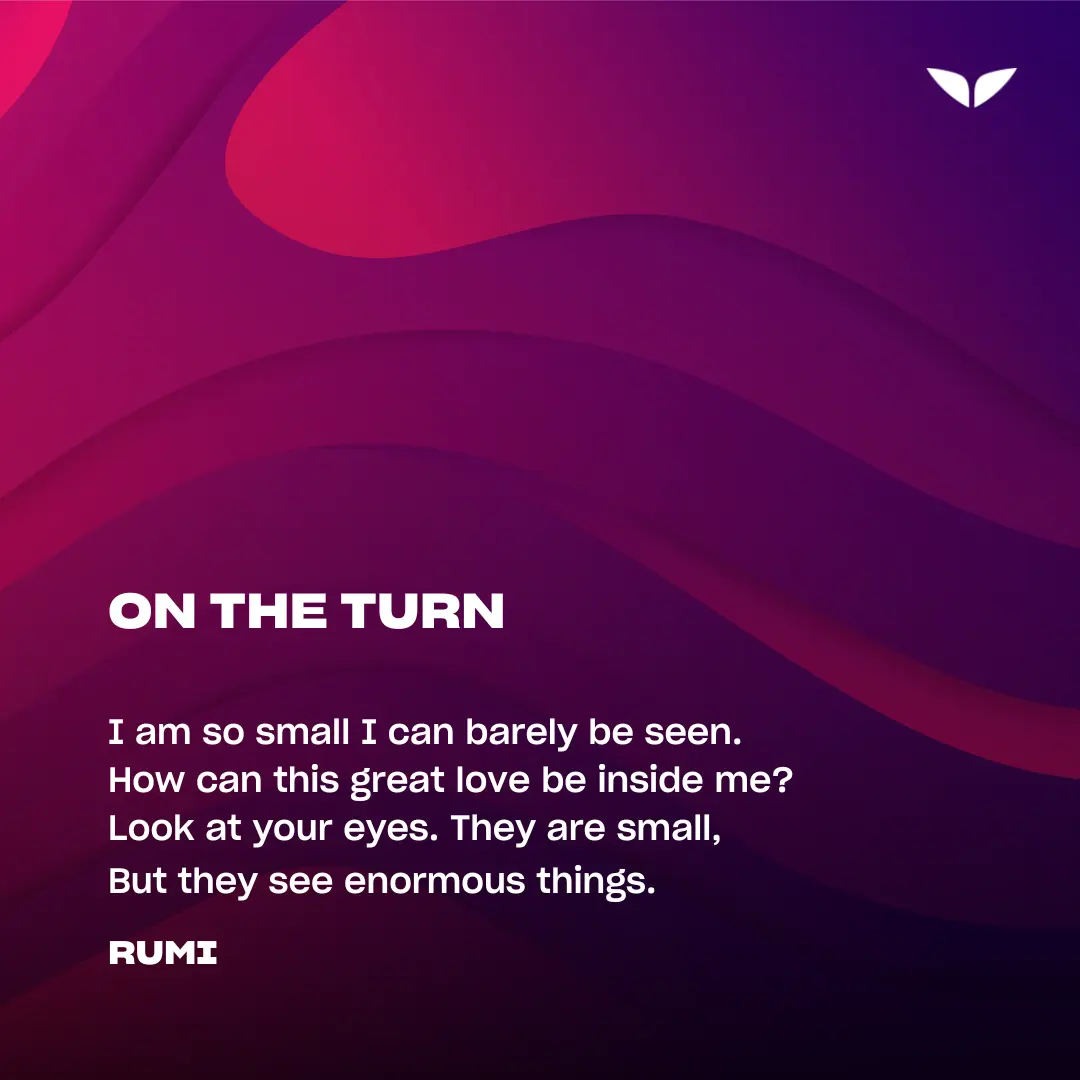
At the Flip
I’m so small I will be able to slightly be observed.
How can this nice love be inside of me?
Take a look at your eyes. They’re small,
However they see monumental issues.
The Persian poet certain has some way of reminding us that dimension doesn’t decide affect. Even supposing we really feel small, we cling immense love and possible inside of us.
The comparability to eyes is becoming—tiny however able to perceiving the vastness of the universe. It’s a phenomenal nudge to seem past appearances and consider the ability inside of, regardless of how invisible or insignificant it’s going to appear.
Incessantly requested questions
What’s Rumi well-known for?
Rumi is known for poetry that speaks to the guts of what it method to be human. His phrases discover love, loss, longing, and the deeper seek for which means.
What makes him stand out, even though, is how undying and relatable his concepts are. Other folks throughout cultures nonetheless connect to Rumi’s paintings as it doesn’t really feel tied to a particular time or position—it’s common.
He’s additionally a go-to for someone involved in spirituality or mindfulness. His poetry blends mysticism with emotional knowledge, providing convenience and perception in an international that’s ceaselessly overwhelming. Plus, due to translators like Coleman Barks, Rumi’s paintings has change into extremely available, particularly within the West, making him one of the vital most-read poets within the U.S.
What additionally assists in keeping Rumi related is how his poetry speaks to trendy demanding situations. Whether or not it’s about navigating relationships, discovering inside peace, or coping with lifestyles’s uncertainties, his phrases really feel simply as significant as of late as they did centuries in the past.
That’s why students, non secular seekers, and on a regular basis readers stay coming again to him—Rumi’s poetry is lovely, however it additionally serves as a information to figuring out ourselves and the arena round us.
What number of poems did Rumi write?
Rumi is assumed to have written over 40,000 verses of poetry, even though the precise depend can range relying on how his works are compiled.
His most renowned assortment, the Divan-e Shams-e Tabrizi (The Amassed Poems of Shams of Tabriz), incorporates about 3,200 odes and quatrains devoted to his non secular significant other Shams.
Every other primary paintings, the Masnavi-ye Ma’navi (Non secular Couplets), spans six volumes and comprises round 25,000 verses exploring profound non secular and philosophical concepts.
In combination, those works make up one of the richest poetry in Persian literature, resonating with readers throughout time and cultures.
What’s Rumi’s most renowned poem?
In case you’ve ever heard of “The Visitor Space,” why it’s one of the vital extra well-known of the Rumi poems. It’s easy, profound, and by some means feels find it irresistible’s talking at once on your soul.
The poem compares our feelings to visitors visiting a space—pleasure, sorrow, anger, even depression—and reminds us to welcome all of them. Why? As a result of each and every one presentations up with a lesson or somewhat of knowledge, even the cruel ones.
What makes “The Visitor Space” so particular is the way it speaks to everybody, regardless of the place they’re from or what they imagine. Its message of embracing lifestyles’s ups and downs hits house, making it undying and deeply resonant.
Free up your brilliance inside of
Rumi as soon as stated, “Reply to each name that excites your spirit.” It’s a call for participation to embody what evokes you, to discover the unknown, and to develop in ways in which resonate deeply.
With a loose Mindvalley account, you’ll achieve get admission to to transformative assets that uplift your soul—like day by day meditations, previews of decided on quests, and a supportive neighborhood. Even Vishen attracts on knowledge like Rumi quotes in his teachings, connecting historical insights with trendy non-public enlargement.
It’s a small step that can result in profound shifts, opening doorways to the type of inspiration present in Rumi’s well-known poems and past.
Welcome in.

