

Be thankful, they mentioned. There’s such a lot to be thankful for, they mentioned. It’s the important thing to happiness, they mentioned.
However they by no means mentioned that gratitude has a depressing aspect.
No person talks about what occurs when it’s more uncomplicated to shrink your emotions than admit one thing hurts. Or while you smile thru a role that drains you or a dating that numbs you, as a result of…properly, no less than you’re now not on my own, ravenous, or in poor health.
There’s a reputation for this. It’s referred to as poisonous gratitude, the sort that appears like knowledge at the outdoor. However within, it’s emotional self-abandonment.
The article is, we get so busy being grateful, we overlook to be fair with ourselves.
And that ends right here.
What’s poisonous gratitude?
Poisonous gratitude is while you use thankfulness to betray your self. It’s the voice that whispers, “You must be thankful,” even if one thing feels fallacious. As an alternative of honoring your discomfort, you override it with compelled appreciation. That development can stay you feeling caught in existence, the place you appear nice from the outdoor however are quietly tired from the interior.
“Poisonous gratitude is both escaping the truth or manipulating other folks or handiest that specialize in the great factor with out acknowledging fact,” explains Mel Robbins, a New York Occasions bestselling writer and a relied on knowledgeable in private expansion, in one in every of her podcast episodes.
Whilst it’s recognized to have its advantages, researchers now warn that gratitude, when paired with guilt or legal responsibility, can cause emotional suppression and disgrace.
So what feels noble at the floor, beneath, poisonous gratitude is solely otherwise we gaslight ourselves into staying small.
The place does poisonous gratitude come from?
Poisonous gratitude is when any individual feels compelled to be grateful, even in eventualities the place they’re being harm, mistreated, or unsatisfied. It’s stitched into your fearful machine, in most cases from a tender age.
Possibly you grew up listening to, “You must be thankful. You have got meals, garments, and a roof over your head.” Or possibly your emotions have been met with silence, scolding, or answers as an alternative of house. Someplace alongside the best way, you realized that convenience makes you egocentric and ache makes you ungrateful.
Psychologists name this emotional invalidation. It teaches you to distrust your inside alerts and change them with socially licensed scripts.
So as an alternative of feeling disappointment or anger or announcing, “This isn’t proper for me,” you fast-forward to gratitude and say, “Other folks have it tougher.”
This sort of self-talk steadily alerts emotional suppression, explains authorized therapist Jenna Nielsen, LCSW. She says, “More often than not other folks use the phrase ‘must.’ [It] signifies a judgement which isn’t rooted within the info.”
And as soon as that inside voice will get educated to downplay ache, the outdoor global finishes the process.
You pay attention the messages that sound useful however quietly put on you down. Those come with the quotes about hustling tougher, the recommendation wrapped in compelled gratitude, and the realization that you wish to have a dramatic explanation why to really feel unsatisfied.
Over the years, you forestall being attentive to the a part of you that’s drained or hurting, persuade your self it’s now not a large deal, and swallow your fact within the identify of standpoint. However silencing your ache with a grin isn’t resilience. Whilst you use gratitude to steer clear of your ache, it’s non secular bypassing in cover.
And also you don’t owe any individual that efficiency.
6 indicators you’re stuck in poisonous gratitude
In the similar podcast episode, Mel brings up poisonous gratitude principle, which is the mental concept that while you faux appreciation to steer clear of ache, you lose contact along with your actual emotions. And that assists in keeping you caught.
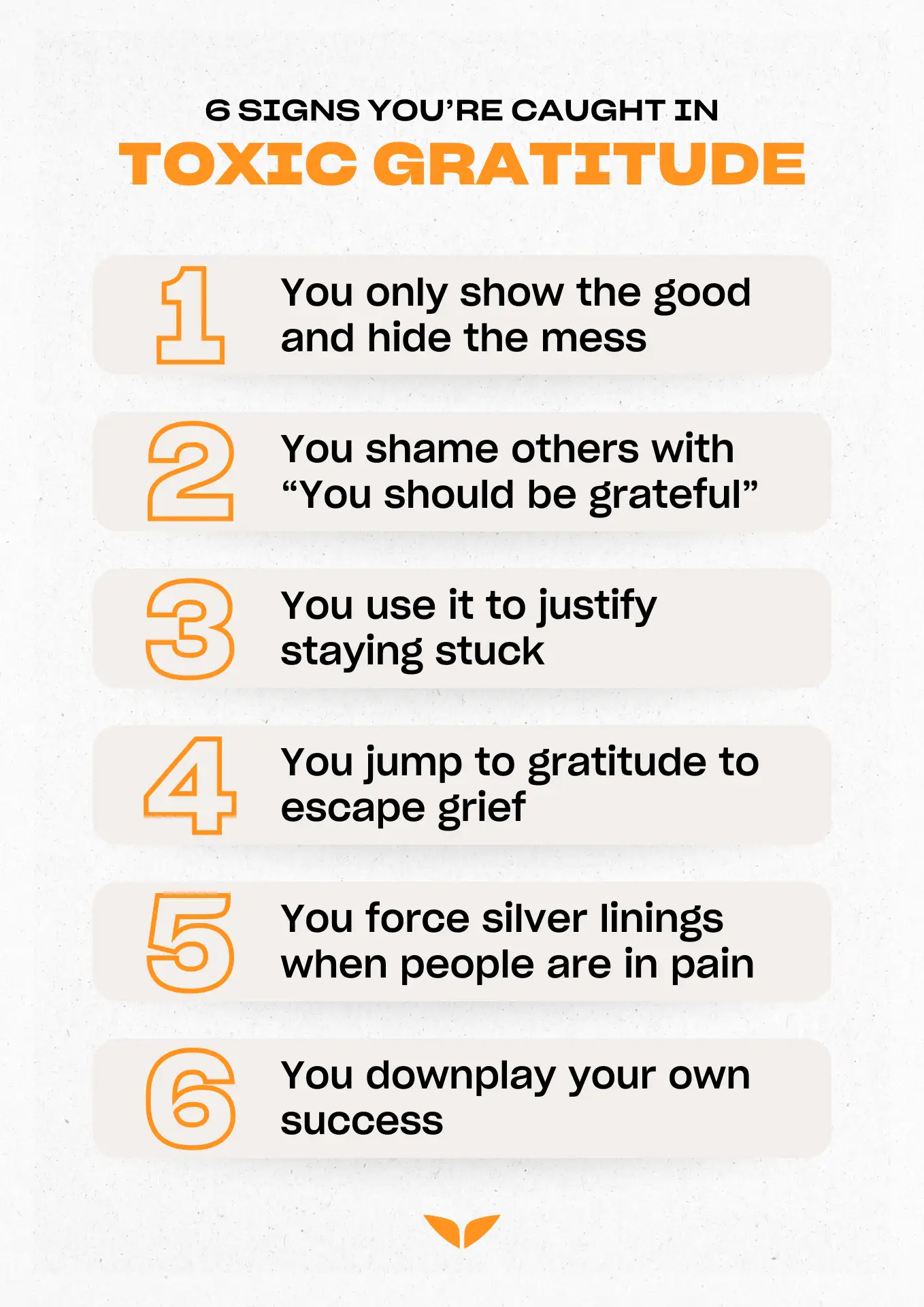
And she or he highlights six kinds of it.
1. You handiest display the great and conceal the mess
You’ll steadily see this on social media with the seaside selfies, the #blessed captions, and the curated pleasure.
Sadly, at the back of the scenes, the similar particular person vents nonstop about how unsatisfied they actually are.
2. You disgrace others with “You must be thankful”
This one’s sneaky as it appears like parenting knowledge.
As an example, in case your child complains about dinner, you assert, “You must be thankful you might have meals.” Or in the event that they cry after a loss? “You must be satisfied you made it this a long way.”
Pressured appreciation must by no means be used to guilt any individual into silence.
3. You employ it to justify staying caught
Right here’s how this one may glance: you may be thankful for their process, however you hate going to paintings. Otherwise you say you’re thankful for the connection you’re in, however it drains you.
Being grateful turns into some way to provide an explanation for away your struggling. And the one factor you’re actually doing is shaming your self into settling.
4. You leap to gratitude to flee grief
Let’s say any individual you deal with passes away, and the very first thing you assert is, “No less than they’re now not struggling.” Whilst that may well be true, it skips over your heartbreak.
Gratitude turns into a existence raft while you’re drowning in emotion. As an alternative of feeling the grief, you attempt to bypass it.
However in actual fact, wholesome processing begins with naming what hurts.
5. You power silver linings when persons are in ache
It’s most likely you might have buddies who’ve long past thru one thing hectic, like a illness or a life-changing loss (assume: chapter or divorce). Your intuition may well be to mention, “You’re going to overcome it” or “You’ll soar again.”
You don’t imply any hurt. However what they actually want is honesty, now not sunshine.
A softer technique to reply may well be, “That sucks. You don’t deserve this. I’m right here.” It’s extra grounding than any polished platitude.
6. You downplay your personal luck
Do you’re employed arduous, push thru tricky instances, and nonetheless say, “I’m simply thankful to be right here”?
That can sound humble, however it leaves out the reality: that you just confirmed up, you probably did the paintings, and also you made it occur.
Being thankful doesn’t wish to erase that. It’s ok to mention, “I earned this.”
The hazards of poisonous gratitude, consistent with science
When gratitude is misused, the hurt may also be actual. Listed here are a couple of science-backed techniques it will possibly quietly put on you down.
- Mental and emotional dangers. Ceaselessly pushing down your true emotions has been connected to raised ranges of despair, anxiousness, and feeling much less happy with existence. Individuals who do that steadily additionally say they really feel misplaced, at a loss for words, or disconnected from what actually issues to them.
- Cognitive penalties. Gratitude can from time to time create distorted considering, particularly when it’s used to justify conduct that doesn’t really feel proper. This can result in guilt, decreased self belief, and staying in eventualities out of legal responsibility reasonably than fact.
- Thoughts–frame penalties. Repressing feelings can elevate rigidity ranges, weaken your immune reaction, irritate psychological well being, or even put your general well-being in peril.
- Compromised emotional therapeutic. Skipping the entire enjoy of destructive emotion, similar to grief, can result in not on time or extended grief reactions. Lengthy-term results come with sophisticated grief, main despair, and social isolation.
- Compassion deficit. When emotional ache is masked with poisonous positivity and gratitude, it steadily presentations up as efficiency. This invalidates actual emotions and quietly drives disconnection, even in shut relationships.
That’s the article with poisonous gratitude—it narrows your standpoint. You forestall seeing the entire image and get started filtering fact thru a unmarried lens of “what you must be pleased about.”
Jenna calls this an excessive view of gratitude, person who blocks out the info. And when that occurs, you’ll most likely in finding your self caught in a model of the tale that isn’t even true.
The variation between wholesome vs. poisonous gratitude
Most of the people don’t notice they’ve slipped from actual gratitude into one thing performative or guilt-based. The road is delicate, however the emotional affect isn’t.
Right here’s the right way to spot the variation:
| Wholesome gratitude | Poisonous gratitude |
| Feels grounding and true | Feels compelled, hole, or guilt-driven |
| Recognizes each the great and the arduous | Ignores ache, discomfort, or unmet wishes |
| Strengthens self esteem and readability | Lowers self belief and blurs emotional barriers |
| Encourages expansion, alternate, and fact | Assists in keeping you caught in eventualities that not are compatible |
| Comes from selection and presence | Comes from power, legal responsibility, or comparability |
| Deepens reference to self and others | Disconnects you from what you actually really feel |
The way to apply actual gratitude with out the guilt
You’ll’t faux your method into gratitude. The shift from poisonous to actual starts when you are making house in your exact feelings and discover ways to cling them with out flinching.
Gratitude is a gorgeous instance of long-term technique over rapid gratification.
— Kristina Mӓnd-Lakhiani, co-founder of Mindvalley and teacher of the From Superior to Flawesome program
Those 3 insights, pulled from mavens who’ve studied emotional well-being for many years, help you rebuild your dating with gratefulness from the interior out.
1. Gratitude as a long-term technique, now not a handy guide a rough repair
Kristina Mӓnd-Lakhiani, the co-founder of Mindvalley, calls gratitude some of the six practices that elevate your “set level of happiness.” True, it doesn’t drown you in dopamine. However through the years, it recalibrates your fearful machine in profound techniques.
“Gratitude is a gorgeous instance of long-term technique over rapid gratification,” she explains at her degree speak at Mindvalley College 2017. “It doesn’t make you are feeling euphoric… it simply makes you are feeling somewhat bit higher… However in the event you specific gratitude every day for 30 days, your belief of your personal happiness is going up 25%.”
That’s the brilliance of this sense. It doesn’t wish to knock you over the pinnacle with bliss to paintings; it’s quieter than that. It builds like muscle: sluggish, stable, and steadily left out…till in the future, your baseline feels other.
Be informed extra from Kristina:
2. Acknowledging destructive feelings as crucial
In the similar degree speak, Kristina additionally warns towards a rising epidemic in private expansion circles: the compulsive wish to “keep certain” and sugarcoat disappointment, unhappiness, jealousy, or anger with faux-enlightened soundbites.
However gratitude isn’t a shortcut round discomfort. It’s what comes after you’re fair with your self.
“You recognize that [the feeling] exists,” she says. “You give it a real and honest and fair identify with out non secular bypassing.”
However emotional fact isn’t all the time simple. Many of us deflect their ache with comparisons. They are saying, “I must simply be thankful,” particularly when others are suffering extra.
Consistent with Jenna, even though, that is steadily an indication of self-invalidation. “Gratitude can completely be used to steer clear of or suppress emotions of grief, anger, and worry,” she says. “They are attempting to steer clear of anger via looking to be thankful… which might make the feelings increase through the years and change into damaging.”
That quiet judgment trains you to cover your discomfort as an alternative of assembly it. However while you face your feelings as an alternative of bypassing them, gratitude in the end has someplace cast to land.
3. Gratitude isn’t a tick list; it’s a felt sense
Gratitude isn’t: well being, test; roof over your head, test; meals within the refrigerator, test. That’s considering gratitude, now not feeling it.
And as Srikumar Rao, the founding father of The Rao Institute and teacher of Mindvalley’s The Quest for Non-public Mastery program, places it, “Gratitude isn’t a considering factor. You if truth be told need to really feel gratitude.”
The issue is, maximum folks are living in our heads. We attempt to common sense our method into happiness. However you’ll’t spreadsheet your technique to peace.
Actual gratitude begins to upward push while you forestall intellectualizing and get started experiencing. And also you do this via connecting the dots, like noticing how every piece of your existence suits in combination in techniques you didn’t be expecting or how even your setbacks had hidden palms guiding them.
One Mindvalley member and pupil of Srikumar, Benie Bernadatte, says she “realized to not prohibit the demanding situations however to problem the bounds, in addition to to be pleased about each problem.” Over the years, she grew grateful for every one as a result of they constructed energy, formed her personality, and printed portions of herself she by no means knew have been there.
Srikumar suggests weaving the ones existence threads right into a tale. Now not simply “I’m thankful for my house,” however “As a result of I’ve a house, I slept properly, awoke clear-minded, and may display up absolutely for any individual who wanted me.”
You’re making house for the sensation as an alternative of forcing it. And when it comes, gratitude starts to shift from legal responsibility to fact.
Embody on a regular basis magic
There’s a distinction between non secular effort and emotional exhaustion. One brings you house to your self, whilst the opposite burns you out looking to break out.
In the event you’ve spent years doing the studying, journaling, and meditating however nonetheless really feel tangled within, you may simply be able for deeper equipment.
Mindvalley’s unfastened sources library exists for that specific second. Inside of, you’ll in finding…
- Downloadable guides,
- Skilled-led categories,
- Self-assessments, and
- Immersive webinars designed to satisfy you the place you might be.
Those equipment are constructed that will help you get clean, construct self-trust, and really feel secure to your personal fearful machine once more. For some, that shift starts with one thing easy, like understanding how arduous it’s to specific like to the individuals who subject maximum, or understand how a gratitude workout brings up greater than anticipated.
For others, it is going even deeper. Nelli Aedla, a pupil of Kristina Mӓnd-Lakhiani’s Mindvalley program, stocks on Mindvalley Tales how the forgiveness meditation and gratitude apply helped her free up years of emotional weight. She says:
Utterly robust with letting cross of items I’ve been sporting with me for years.
And each device on this library is taught via one in every of Mindvalley’s world-class lecturers: Vishen, Kristina Mӓnd-Lakhiani, Jim Kwik, Jon & Missy Butcher, Marisa Peer, and extra.
Regardless of the place you’re status at the moment, something’s evidently: are available with the mess, go away with one thing cast.
Welcome in.

